


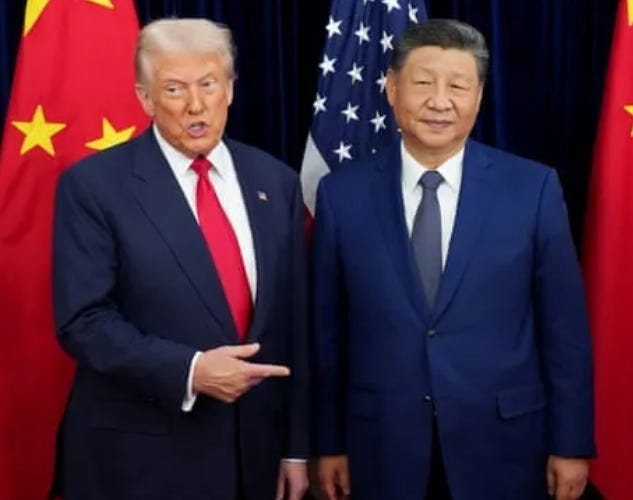
Two men. Two formations. Two completely different theories of power.
One spent seven years in a flea-infested cave, denounced by his own mother, rejected eight times by the Communist Party, watching his sister hang herself from a shower rail. He is now Chinese President Xi Jinping.
Xi emerged from the cave not as a cynic but as a zealot. This is the crucial distinction. The cynic sees through the ideology and manipulates it. The zealot has passed through the fire and been purified by it.
He does not resent the Party for his suffering. He thanks it for the crucible.
Mao broke his family, and Xi responded by becoming more Maoist than Mao. This is not paradox. This is the logic of the true believer.
The other spent his formative years in Manhattan real estate, learning that everything is a deal, everyone is ripping us off, and the only thing that matters is not being laughed at.
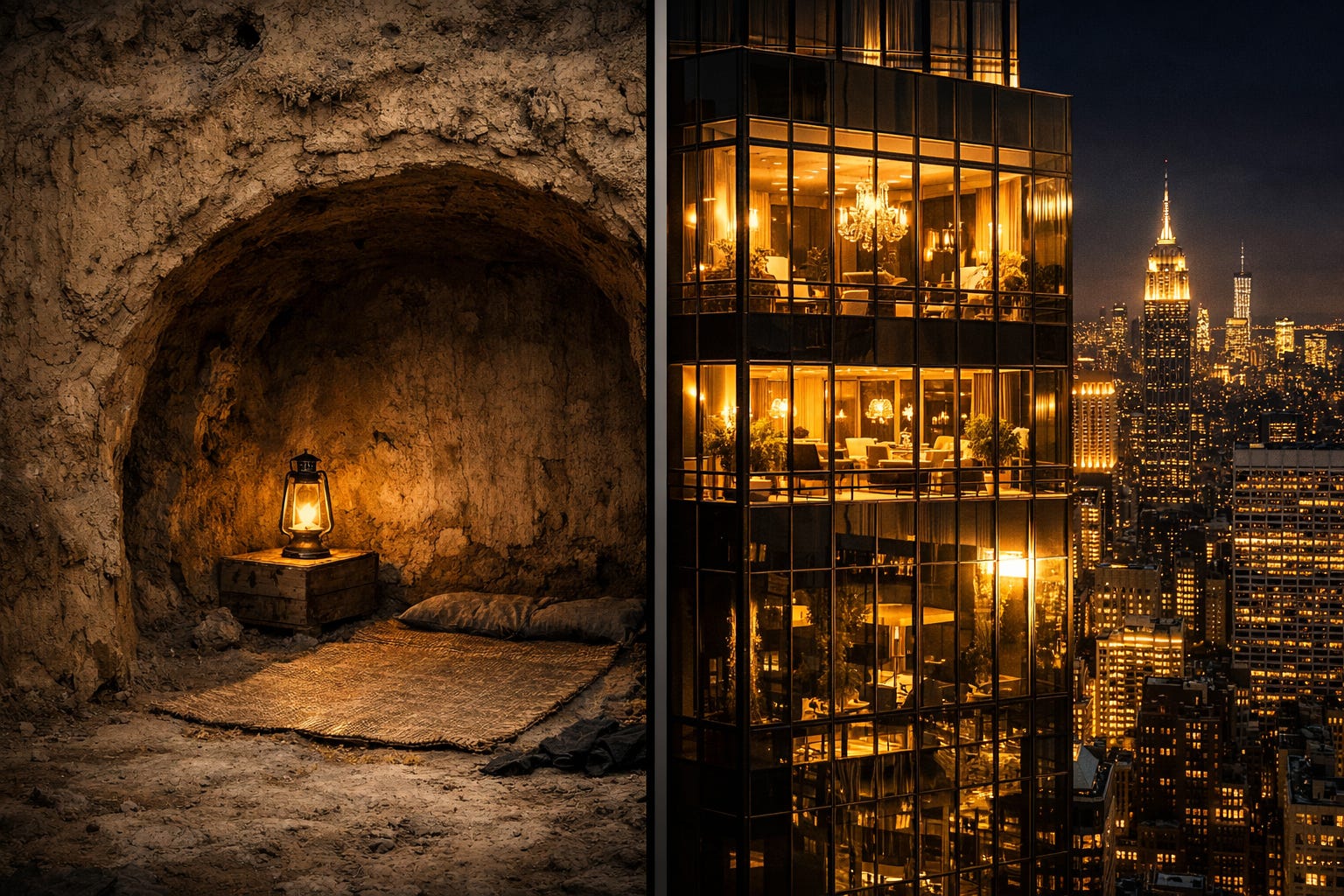
Then he lost.
He was impeached, indicted, convicted. Ninety-one felony charges across four jurisdictions.
Banned from the platforms he had mastered. Pronounced politically dead by every respectable institution in American life, including much of his own party. The obituaries were filed. The Republican establishment auditioned replacements.
Then a bullet missed his brain by less than an inch.
He stood up with blood running down his face, raised his fist, and shouted “Fight, fight, fight.” The photograph will outlive everyone reading this sentence.
Trump before Butler, Pennsylvania was a politician who thought he was special. Trump after Butler is a man who believes God intervened to save him for a purpose.
That is a different creature entirely.
He came back and won three million more votes than before and won the popular vote, the first Republican to do so since 2004. He is now President Donald J. Trump.
Xi is a zealot for the Party. Trump has become a zealot for Providence.
This is not the asymmetry the analysts expected. They predicted a transactional narcissist against a disciplined ideologue.
What they got instead are two men who each believe they survived destruction because history, or heaven, was not finished with them.
Xi’s faith is doctrine. He can recite it. Trump’s faith is instinct. He feels it. One is disciplined by his beliefs. The other is unleashed by them.
On Saturday, in Qiushi, the Chinese Communist Party’s flagship ideology journal that nobody in Washington bothers to read, Xi Jinping announced his intention to replace the US dollar as the world’s reserve currency. Not “expand the renminbi’s role.” Not “diversify the international monetary system.” Replace.
The man who survived the cave, the mother, the sister, the eight rejections, is coming for the throne.
The West has experience with true believers.
It has very little experience with what happens when two of them, shaped by completely different crucibles, sit across the table from each other, each convinced that his survival was not luck but destiny.
You’re about to learn something that will change how you see every headline about US-China relations for the rest of your life.
Not trade policy. Not tariffs. Not rare earth metals. Not semiconductors. Not TikTok. Not Taiwan. Not Peter Navarro’s charts.
Psychology.
Notice what they never mention: the cave.
When the father falls in China, the whole family falls.
Xi Jinping’s father was a revolutionary hero. One of Mao’s original comrades. Vice Premier of the People’s Republic of China.
In 1962, he approved a novel about his old mentor, and for that crime against ideological purity, Mao’s enforcers destroyed him. Purged. Denounced.
Beaten deaf in one ear by Red Guards. Locked in a cell so small he couldn’t lie down for eight years. Couldn’t recognize his own sons when he finally saw them again.
From 1969 to 1975, American teenagers were at Woodstock, then protesting Vietnam, then talking about peace and love and changing the world.
You know who was actually changing?
A fifteen-year-old kid living in a cave in Shaanxi Province, learning that the world doesn't give a fuck about peace and love. The world gives a fuck about power.
He paid attention.
What follows is a psychological portrait of the two men who will determine whether your children grow up in an American century or a Chinese one.
By the end, you’ll understand why Richard Nixon saw this coming in 1978 and Bill Clinton secretly called him for advice even though Clinton’s wife helped write Nixon’s impeachment papers.
Let’s begin in Shaanxi Province, 1969. The cave is still there. You can visit it. The Communist Party turned it into a shrine.
Of course they would.
The Cave
Xi Jinping was born communist royalty.
His father, Xi Zhongxun, was Vice Premier of China from 1959 to 1965, First Secretary General of the State Council, one of Mao’s inner circle. A founding revolutionary who helped create the communist base area that saved Mao Zedong in 1935.
The elder Xi had joined the Communist Party at age 14 while in prison for attempting to poison a “reactionary” schoolteacher. By 19, he was one of the youngest revolutionary leaders in China’s northwest.
Mao himself wrote calligraphy for Xi’s father: “The Party’s Interests Come First.” This became the family creed.
Young Xi Jinping attended Beijing’s most elite boarding school, where children of high-ranking cadres underwent military training and read books like “Be a Successor to the Revolution.” He was a princeling. He was destined to lead.
Then everything collapsed.
When Xi Jinping was nine years old, his father was purged from the Party for approving the publication of a novel about his mentor that Mao saw as anti-Party.
Xi Zhongxun was forced to confess that he had tried to “use propagandizing a dead person to propagandize the living me.”
Twenty thousand people were persecuted as part of the “Xi Zhongxun anti-party clique.” At least 200 were beaten to death, driven mad, or seriously injured.
Zhou Enlai, the Premier, told Xi’s mother Qi Xin to make sure her husband did not kill himself. Xi Zhongxun described his disorientation at being persecuted by the organization to which he had devoted his life as feeling like “a person who fell off an 18-floor building.”
It got worse.
When the Cultural Revolution ignited in 1966, Red Guards from a neighboring province kidnapped Xi Zhongxun from the factory where he’d been exiled. They put a mask on his face, threw him on a train, and brought him to “struggle sessions” where crowds screamed accusations while he stood with a heavy placard around his neck.
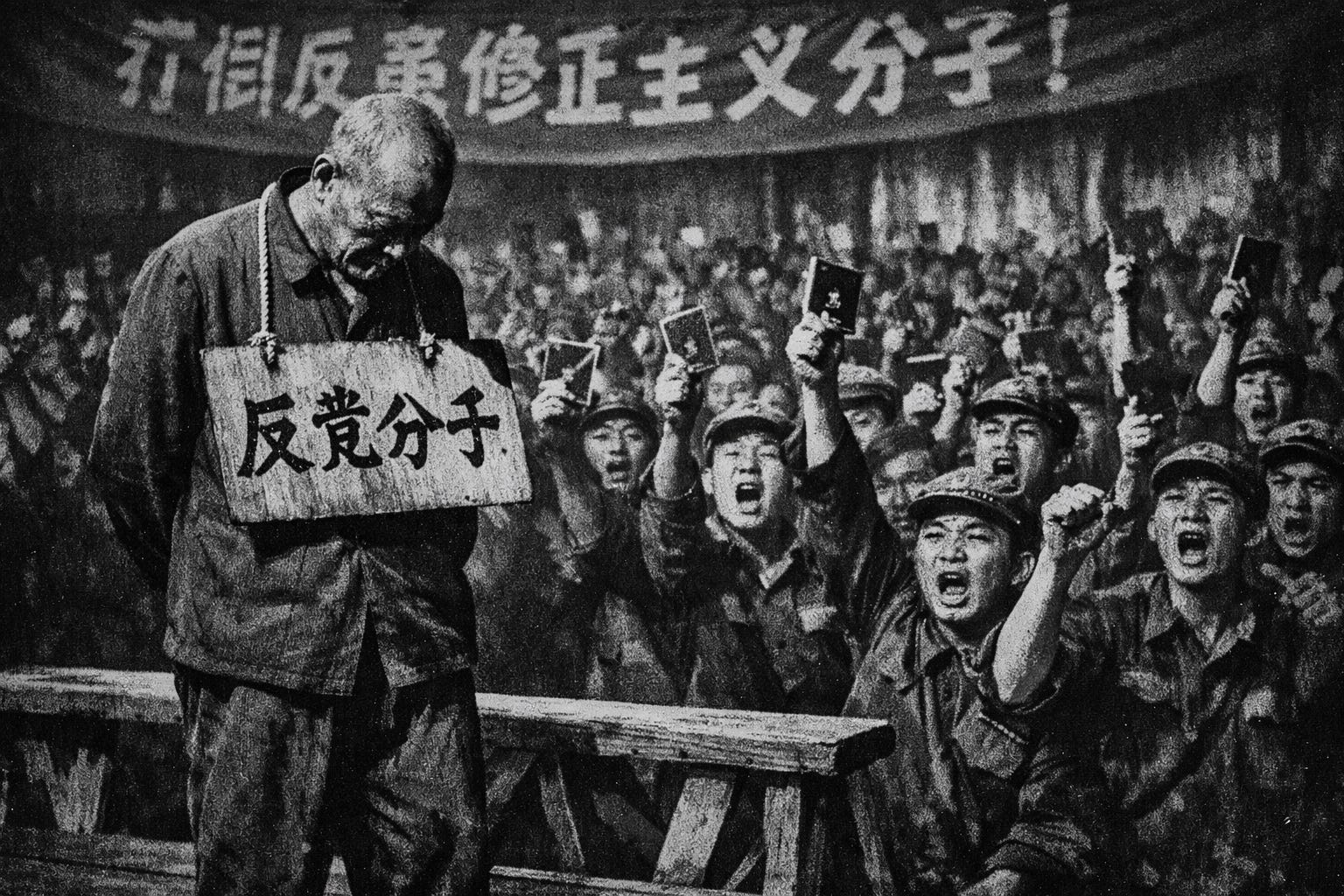
He was beaten so badly he became permanently deaf in one ear.
He was confined in near-total isolation, in a room measuring 7-8 square meters, from 1968 to 1975. He did not see his family for eight years. When briefly reunited with them in 1972, he could not tell his two sons apart.
He developed what we would now call PTSD. One evening a neighbor found him drinking cheap liquor and crying alone in the dark.
It was his son Xi Jinping’s birthday.
Xi Jinping’s half-sister, Xi Heping, hanged herself from a shower rail in 1975 after a decade of persecution. Close associates have confirmed it was suicide. Unconfirmed reports say this was one of the only times Xi Jinping was ever seen crying.
Student militants ransacked the Xi family home. Xi’s mother, Qi Xin, was forced to publicly denounce her own husband as he was paraded before crowds as an enemy of the revolution.
Now here is where the story turns from tragedy to something darker.
In 1966, Xi Jinping, age 13, was essentially held captive at the Beijing Party School. His own mother participated in struggle sessions against him while he wore a heavy steel cap designed for adults.
When he ran away from the school to find his mother and beg her for food, she refused to feed him and then personally reported him to the authorities. He was placed in juvenile detention.
Let that sit for a moment. His own mother turned him in.
In a 1992 interview with the Washington Post, Xi recalled being locked up “three or four times” when he was 15. He was forced to attend daily struggle sessions where he had to denounce his own father.
“’Even if you don’t understand, you are forced to understand,’ he said with a trace of bitterness. ‘It makes you mature earlier.’”
In 1969, Xi Jinping was 15 years old. Mao’s “Down to the Countryside Movement” sent him to Liangjiahe, a village in Shaanxi Province. Population 300. No electricity. No running water. People survived on millet and corn.
He lived in a yaodong, a cave dwelling carved into the hillside. Flea-infested. He hauled grain, carried manure, built irrigation ditches.
After a few months, unable to stand rural life, he ran away to Beijing. He was arrested during a crackdown on deserters and sent to a work camp to dig ditches. He was persuaded to return to the cave.
He applied to join the Communist Party. They rejected him. He applied again. Rejected. He applied eight times (some sources say ten) before they finally accepted him in 1974. His father was still in prison.
A family friend said Xi chose to survive by becoming “redder than red.”
He read Marx and Mao by kerosene lamp. He stayed for seven years. He later said he “suffered more than most people.”
The cave didn’t break Xi. It forged him.
His father later bragged that precisely because he had doubted the Party for a moment and still returned, his dedication was “even more powerful than someone who didn’t have to suffer.”
Xi learned three things in that cave: The Party can destroy anyone. The Party is the only path back. And patience is a weapon.
The Penthouse
While Xi was picking fleas off his body in Shaanxi Province, Donald Trump was learning about power in Manhattan real estate.
Trump’s worldview crystallized in the 1980s. Japan was the enemy. They were “laughing at us.” In 1987, he paid $100,000 to print an open letter in the New York Times, Washington Post, and Boston Globe: “Let’s not let our great country be laughed at anymore.”
This was 1987. He’s held the same view for nearly 40 years. The only thing that changed was the country. Japan’s economy collapsed. China rose. Trump swapped the name and kept the script.
His framework: The world is a negotiation. Everyone is ripping us off. Strength means never being laughed at. Everything is a deal. Winning is the only metric.
The key difference: Trump learned that power means getting the yes. Xi learned that power means surviving the no.
Trump’s China Education
Starting in 2006, Trump tried to break into China. Trademark applications. Hotel deals. Licensing agreements. For a decade, China said no.
In 2008, he pursued a deal with Evergrande Group for an office tower in Guangzhou. Collapsed.
In 2012, he partnered with State Grid Corporation of China, their largest state-owned company, for a Beijing development. Abandoned after a corruption investigation.
From 2005 to 2016, Trump filed at least 130 trademark applications in China. Hotels, restaurants, spas, escort services, massage parlors. Approvals: zero.
Then November 2016. Trump wins the presidency.
Within months, China approved 38 trademarks.
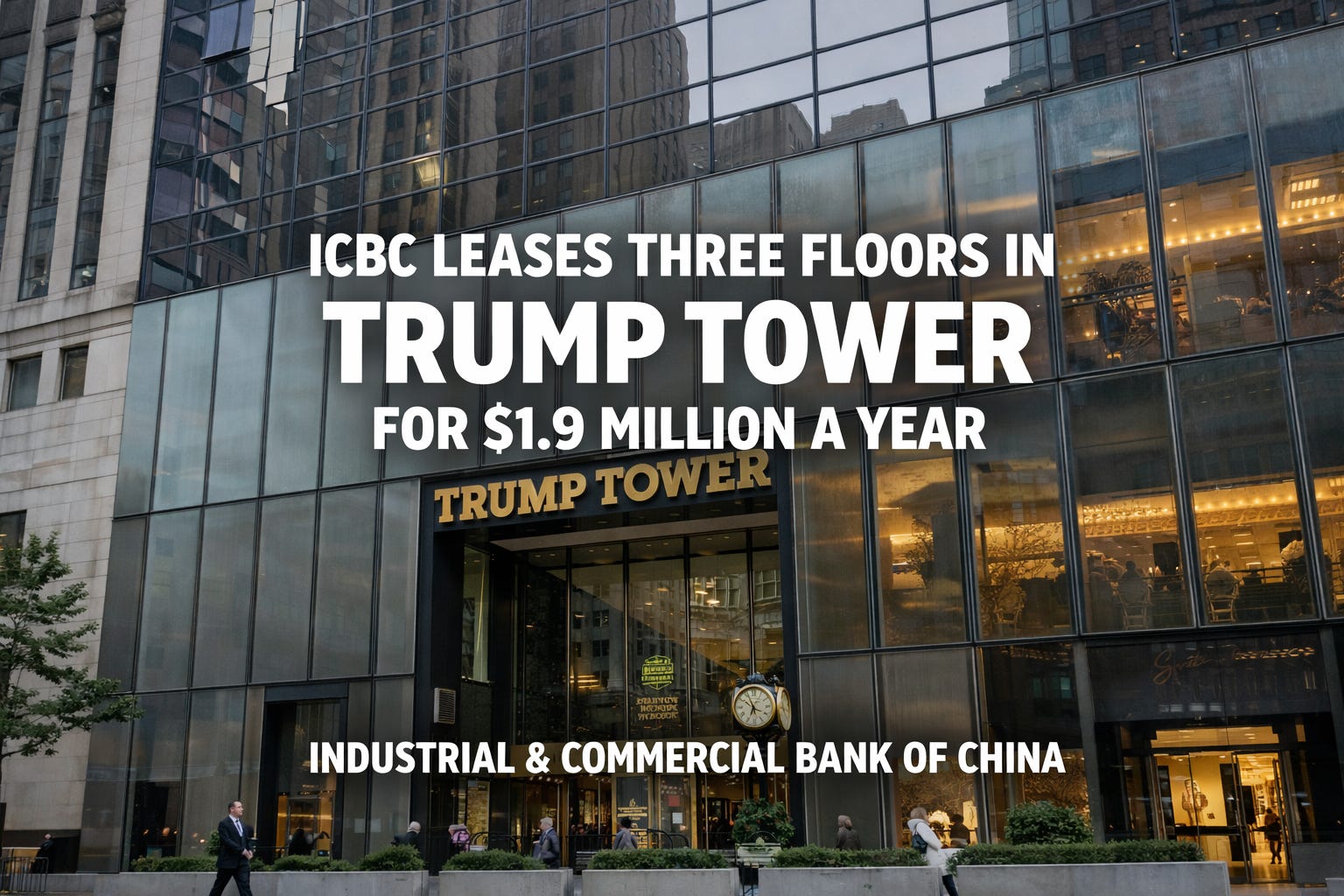
The Industrial and Commercial Bank of China, the largest bank in the world, was already leasing three floors in Trump Tower. $1.9 million annually. Trump bragged about it: “I have the best tenants in the world.”
Chinese government-controlled entities spent over $5.5 million at Trump properties during his first term.
China rejected Trump the businessman for a decade. China embraced Trump the President immediately. They were showing him how power works in their system.
He thought he’d finally arrived. They were taking his measure.
The Chocolate Cake Summit
In Which Two Leaders Eat Dessert, Launch Missiles, and Demonstrate Two Completely Different Theories of Dominance
April 2017. Mar-a-Lago. Less than three months after inauguration.
Trump’s grandchildren sang Chinese folk songs. Recited classical poetry in Mandarin. Videos went viral in China. This was Trump projecting warmth.
Trump and Xi ate what Trump called “the most beautiful piece of chocolate cake you’ve ever seen.”
Over dessert, Trump got word that the Syria strikes were underway. He told Xi at the table. This was Trump projecting strength: I can launch missiles while we eat dessert. Are you impressed?
What Xi saw: a man who needs his dinner guest to know he’s powerful. The cave teaches you to read that kind of need. And to use it.
Trump called the relationship “outstanding.” Xi called it “a preliminary working relationship.”
One man was selling. The other was taking notes.
Trump thought Mar-a-Lago was a show of strength. It was an audition.
Xi was watching to see what this man needed. Answer: respect, flattery, and the appearance of winning.
What Kissinger Saw
The Man Who Understood That China Is a Civilization Pretending to Be a Country, and What He Got Right and Wrong
Henry Kissinger met Xi multiple times from 2007 until his final visit in July 2023, three months before his death at 100.
When Xi became General Secretary, Kissinger told the Wall Street Journal: “Xi Jinping is a strong leader capable of rising up to any challenge.”
Kissinger saw Xi through a realist lens. A survivor. A rational actor. A man who, like Kissinger himself, had lived through chaos and valued stability above all.
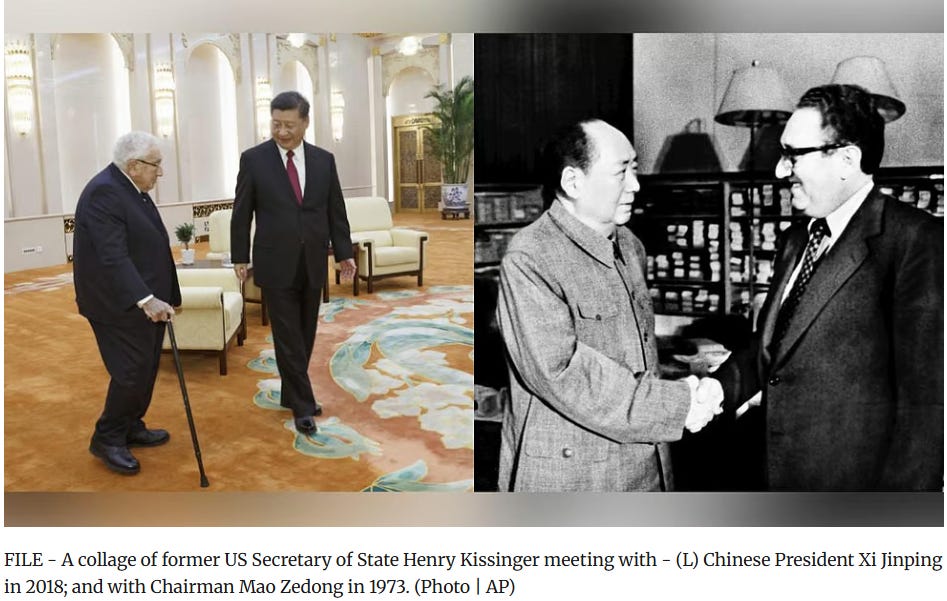
Kissinger believed engagement could work because rational actors choose order over disorder. Trade creates interdependence. Interdependence creates peace.
His blind spot: He underestimated ideology. He saw Xi as a player of the great game. He may have missed that Xi was also a true believer.
The man who applied to join the Communist Party eight times in a cave was not a cynic. He was a convert.
Kissinger understood power. He may not have understood faith.
What Nixon Feared
The Disgraced President Who Saw the Future, the Young President Who Called Him at Midnight, and Why None of This Had to Happen
Before we get to Nixon’s warning, we need to establish why Nixon matters. And that requires a detour through Bill Clinton’s White House.
Here is how respected Nixon was on foreign policy: Bill Clinton, whose wife helped draft his impeachment papers, called him secretly for advice.
After Nixon returned from Russia in 1993, Clinton called him to discuss Boris Yeltsin. But during the call, the new president also asked questions about “the role of the president and work-flow.” He was asking the man who resigned in disgrace how to do the job.
Nixon sent Clinton a letter after he won the presidency: “The strongest steel must pass through the hottest fire. In enduring that ordeal you have demonstrated that you have the character to lead not just America but the forces of peace and freedom in the world.”
Nixon used leverage to get the meeting. He got word to Clinton through back channels: call me for advice on Yeltsin, or I will write an op-ed attacking your foreign policy. Clinton called. But that wasn’t enough. More pressure. Finally, Clinton invited him to the White House, but did it at night when no photographs could be taken.
After Nixon’s death, Clinton said: “I found myself wishing I could pick up the phone and ask President Nixon what he thought about this issue or that problem, particularly if it involved Russia.”
Clinton gave a generous eulogy: “May the day of judging President Nixon on anything less than his entire life and career come to a close.”
So what did Nixon see?
Nixon opened China in 1972 after two decades of frozen relations. He called it “the week that changed the world.” His strategic insight was triangular diplomacy: play China against the Soviet Union, the Soviet Union against China, and both against North Vietnam.
As early as 1967, Nixon wrote in Foreign Affairs: “There is no place on this small planet for a billion of its potentially most able people to live in angry isolation.”
Only Nixon could do it. As an anti-communist hardliner, he had political cover that a Democrat would not have had.
But Nixon also saw the danger.
In his 1978 memoirs, he wrote: “We must cultivate China during the next few decades while it is still learning to develop its national strength and potential. Otherwise, we will one day be confronted with the most formidable enemy that has ever existed in the history of the world.”
He warned that if China ever reverted to the ideological intensity of the 1950s and 1960s, it would pose “an enormous threat to the peace of the world and to the survival of the West.”
The sent-down youth generation had two possible outcomes: cynicism about ideology, or deeper commitment to it.
Nixon feared the latter.
The man who applied to join the Communist Party eight times in a cave, who watched his mother denounce his father, who watched his sister hang herself, who came back redder than red—that man was not a cynic.
Kissinger saw a partner. Nixon would have seen an adversary.
Both were half right. Xi is both: a rational actor AND a true believer. That’s what makes him dangerous.
Why Trump (Not His Advisors)
Why This Piece Is Not About Peter Navarro’s Charts, Marco Rubio’s Speeches, or Robert Lighthizer’s Tariff Schedules
A reasonable person might ask: Why focus on Trump’s psychology? Doesn’t he have advisors? Experts? Doesn’t policy emerge from institutions?
Let me introduce you to Trump’s first-term China team.
Gary Cohn from Goldman Sachs. Peter Navarro, the economist who made a documentary called “Death by China” with a movie poster showing a knife plunging into a map of America, spurting blood. Robert Lighthizer, the trade representative. Steve Bannon. H.R. McMaster. Steve Mnuchin.
They fought constantly.
Steve Bannon: “If you take all the other nastiness on things like the Paris accord and TPP, roll it up and put it to the factor of 10, they don’t compare to these weekly nasty trade meetings. There was a blowup in the Oval Office.”
Navarro’s charts vs. Cohn’s data. McMaster vs. everyone. They agreed on the problem. They disagreed on methodology.
It didn’t matter.
Trump rejected a deal his own secretaries negotiated with China. Trump overruled his advisors on tariffs, then reversed himself, then reversed again. Trump considers himself his own top “China expert.” Quote from early 2024: “I did great with China.”
Second term? The State Department reportedly sacked its top China team in July 2025. China experts are often excluded from major decisions. Rubio is hawkish. Vance is restrained. Navarro is back. Bessent and Lutnick are at the table.
But Trump is still Trump.
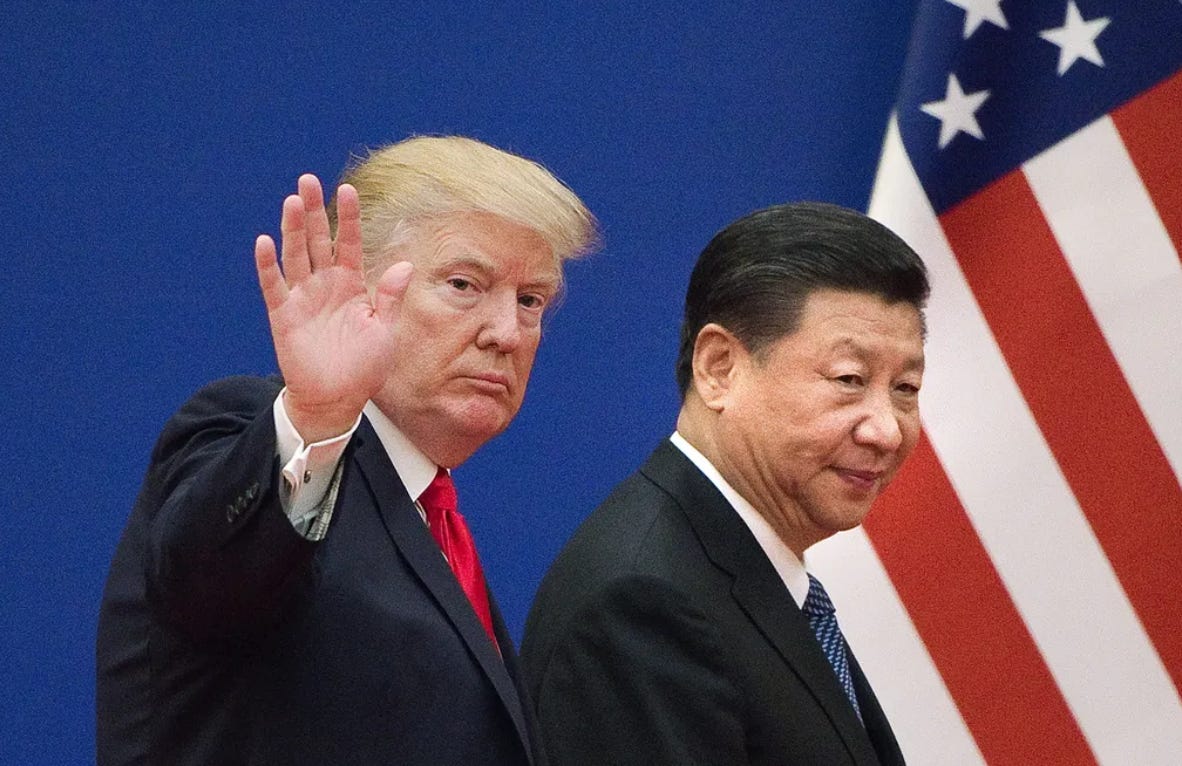
The Trump-Xi personal relationship “restrains” even the most hawkish advisors. They fear “a sharp reaction from the president if they misread his intentions.”
Navarro has a policy. Lighthizer has a strategy. Rubio has an ideology.
Trump has a psychology.
We focus on Trump because Xi is focused on Trump. Xi doesn’t need to understand Navarro’s charts. He needs to understand what Trump needs. The cave taught him to read that.
The answer is: respect, flattery, and the appearance of winning.
Advisors change. Trump’s psychology does not. It’s been the same since 1987.
The Trump Worldview
Everything Is a Deal, Everyone Is Ripping Us Off, and If They’re Not Laughing at Us We Must Be Winning
Trump doesn’t think about China in terms of strategic competition, ideological rivalry, or balance of power.
He thinks: Are they respecting us? Are they laughing at us? Can I get a deal?
His framework is transactional. All relationships are ledgers. All diplomacy is deal-making. Every interaction has a winner and a loser.
He admires strongmen. Not because he shares their ideology, but because he respects the capacity to impose order, to dominate, to command respect.
When Xi removed term limits in 2018, Trump called it “great.” He later joked: “Maybe we’ll have to give that a shot someday.”
Trump recognizes in Xi something he aspires to: unchecked power, no term limits, a country that does what he says.
Trump doesn’t see Xi as an enemy. He sees a peer. A fellow strongman across the table. A man whose respect he craves.
This shapes everything.
The Mismatch
One Man Thinks in News Cycles. The Other Thinks in Dynasties.
The asymmetry was supposed to be temporal.
Xi emerged from the cave with one conviction above all others: patience is a weapon. The man who can outwait his enemy has already won. This is not philosophy. This is survival learned over seven years.
Trump emerged from a lifetime of dealmaking with the opposite conviction: speed is dominance. Close now. Declare victory. Move on. The deal you don’t close today is the deal someone else closes tomorrow.
Xi wanted a century. Trump wanted a headline.
That was the old mismatch. Beijing understood it. Beijing had a playbook for it.
Then Butler.
Trump no longer operates on dealmaker time. He operates on Providence time. The man who believes God stopped a bullet for him is not thinking about the next news cycle. He is thinking about why he was spared.
Xi still wants a century. Trump now believes he was saved for a purpose.
One of them is playing a long game. The other thinks the game has already been decided in his favor.
This is not the mismatch Beijing prepared for.
Busan
A 12 Out of 10, God Bless China and the USA, and Other Things You Say When You’ve Been Played
October 2025. Busan, South Korea. First face-to-face meeting since 2019.
Trump called it “a 12 out of 10” and posted “God Bless China and the USA!”
The deal: China pauses rare earth export controls for one year. Resumes soybean purchases. Promises to work on fentanyl.
In exchange, the US lowers tariffs from 57% to 47%.
Trump announced he’ll visit China in April 2026. Xi will come to the US “sometime after that.” Maybe Mar-a-Lago.
Trump said the deal will be “renegotiated every year.”
Annual renegotiation. Perpetual dealmaking. Trump at the center of attention. This is exactly what he wants.
Trump got a deal. Xi got time. And another year of leverage.
The Bottom Line
Two True Believers Are More Dangerous Than One
The mistake most analysts make is to view US-China relations through the lens of trade policy, as if tariff schedules and soybean purchases were the substance of the matter. They are not. They are the vocabulary. The substance is psychology.
Xi Jinping emerged from that crucible with three convictions that now govern a nuclear state: The Party is everything. Chaos is the enemy. Power is the only protection.
Trump, before Butler, operated from an entirely different catechism: Deals are everything. Weakness is fatal. And winning, defined as the appearance of not losing, is the sole metric of success.
These were not merely different worldviews. They were incommensurable ones. And analysts assumed this asymmetry favored Beijing. The disciplined ideologue would always outlast the transactional narcissist.
Then a bullet missed Trump’s brain by less than an inch.
In 1978, Richard Nixon warned that if China ever produced a leader shaped by ideological suffering into genuine faith rather than protective cynicism, America would face “the most formidable enemy that has ever existed in the history of the world.”
Xi Jinping is that leader.
Nixon did not anticipate that America might produce its own version.
Henry Kissinger, who spent half a century cultivating Beijing, saw in China a partner to be managed. Nixon, the old Cold Warrior, would have seen an adversary to be contained. Both assessments contained truth. Neither was sufficient.
And neither man imagined a scenario in which both leaders believed themselves chosen by forces larger than statecraft.
The old pattern was revealing. They rejected Trump 130 times over ten years. Then they approved him 38 times in his first months as president. The old Trump interpreted this as respect finally earned. It was leverage acquired.
Xi understood what Trump did not: In the long game, the man who controls the yes controls the man who needs it.
This is how Beijing has managed American presidents for decades. It works on dealmakers.
The question is whether it works on a man who believes God stopped a bullet for him.
Xi has been out-waiting adversaries since 1969. He thinks in dynasties. Trump now thinks in Providence. One wants a century. The other believes he was spared for a purpose not yet fulfilled. One is disciplined by his faith. The other is unleashed by it.
They rejected him 130 times. Then they let him win. The old Trump never understood what that meant.
Xi is betting the new Trump still doesn’t.
Xi is usually right. But he has never negotiated with a man who thinks he is unkillable.
Neither has anyone else.
The foreign policy analysts miss what a psychological lens reveals: These are two different species of zealot, forged by two different crucibles, operating on two different clocks.
Xi’s conversion took seven years. Slow. Grinding. The cave taught him that survival requires patience, that time is the ultimate weapon, that the man who can outwait his enemy has already won. His faith has been tested for five decades. It is structural. It does not flex.
Trump’s conversion took seven seconds. The bullet, the blood, the fist, the roar. His faith is new, white-hot, untested by anything except its own origin story. It does not discipline him. It inflames him.
Slow-formed belief structures are more stable but more rigid. Sudden conversions are more volatile but more adaptable. The patient zealot breaks when the world refuses to conform to his timeline. The volatile zealot breaks when the world refuses to give him immediate victories.
Xi needs the long game. Trump needs the quick win.
The danger is this: Trump may not give Xi the long game. He may force chaos, elicit crisis, shatter the patient timeline Beijing has cultivated for decades. This is not strategy. It is temperament. But temperament, in a man with nuclear codes, functions as strategy.
China has waited out every American president since Nixon. Xi intends to continue the tradition.
But Trump is not trying to outwait Xi. He is trying to outwill him. These are different contests. Xi has trained for one. He may be facing the other.
Who wins? The honest answer is: we do not know. We have no precedent. The post-war order was built by rational actors who believed in interests, incentives, and incremental advantage. It was not built for two men who each believe they survived destruction because destiny demanded it.
What I do know is this: Xi’s formation is deeper. Trump’s formation is more volatile. Depth favors the long game. Volatility favors disruption. If this contest is measured in decades, bet on Xi. If it is measured in crises, the outcome is genuinely uncertain.
The one thing I am sure of: the analysts who predicted this would be easy were wrong. A transactional narcissist could be managed. A zealot for Providence cannot be modeled.
They rejected him 130 times. Then they let him win.
Xi learned to survive the no. He learned it over seven years, in the cold, in the dark, picking fleas off his body, reading Marx by kerosene lamp, waiting.
The question he cannot answer is whether Trump has learned anything at all, or whether a man who believes God intervened to save him thinks he no longer needs to.
The cave taught Xi that patience always wins.
Butler taught Trump that he doesn’t have to be patient.
We are about to find out which lesson matters more.
May the mischief be with you.
I May Have Made a Terrible Mistake
When I started Capital Mischief in early October, I told myself I’d turn on paid subscriptions at 3,000 subscribers. I figured it would take a year to get to 1,000, maybe another year to hit 3,000, and then I’d flip the switch.
A gentleman’s pace. Time to figure out what I was doing. Time to decide if I even wanted to do it. Less than four months later I have nearly 4,600 subscribers and followers, growing at 150 a day. 236,000 views. 76 posts. I’m answering 200 comments per post. Random emails. Dozens of uninvited requests to chat privately on Substack.
Some of them, God help me, I actually like.
Cristina had that look on her face, the one she gets when she thinks I’ve finally lost what’s left of my marbles.
“Let me get this straight,” she said. “You’re inviting strangers to my house. People from the internet. To drink bourbon that costs more than my first car.”
She wasn’t wrong. She usually isn’t. That’s the hell of it.
That’s the universe for you. Always laughing. You think you’re planting a garden, and before you know it, you’ve got a small farm. Chickens to feed. Goats that reek. They all have opinions. They all crap everywhere.
I started a newsletter. Four months later, I'm taking money from strangers who now have expectations. This is the bait-and-switch of every American enterprise.
You think you're building something for yourself, and suddenly you're building it for everyone who showed up with a credit card. The Founders wanted life, liberty, and the pursuit of happiness. They didn't mention that happiness comes with a subscription model and a comments section.
I’ve advised six presidents. I built a company with offices in eight countries. I write two columns a week for MarketWatch with a loyal readership. One hit 900,000 views. I’m also writing a novel, which is its own special form of masochism.
I founded R360, which three luxury magazines have called the most exclusive private members club in the world. First-year membership is $186,000.
The membership committee has rejected 75 applicants including 9 billionaires. You need $100 million minimum and a desire to use your wealth for good. We’re not elitist. Eighteen members never went to college. Eleven didn’t finish high school. Half of those are billionaires.
I tell you this to explain why I might be the dumbest smart person you’ve ever met.
I’ve got everything handled. Smooth. And my brain says:
“You know what, Charlie? You’ve got too much free time. Let’s fuck that up. Let’s promise 4,000 people you’ll show up five days a week while writing a novel, two columns, and running a peer-to-peer community for people richer than God.”
I don’t need another job. I have one. Several, actually. I started this because I had things to say that my MarketWatch editors kept strangling with lawyers. I figured a few hundred people might care.
Now there are 4,000 of you. And 210 have already pledged money for something I haven’t even started charging for yet.
So I’m thinking out loud.
If I do this, here’s what it would look like:
I told myself 3,000. We blew past that. Which means the switch could flip tomorrow. Or next week. I haven’t decided. But when it does, every pledge converts instantly. And then prices go up for all new subscribers:
Monthly: $100/month (currently $50)
Annual: $720/year (currently $360)
Founding Member: $2,000/year (currently $720)
The Saturday Mischief Library stays free. Libraries should always be free.
Anyone who pledges before I flip the switch locks in today’s price for life. Not a year. Life. As long as you never cancel, you never pay more.
Why the jump? Because $720 is less than half of one percent of what R360 members pay for access to my brain. And I’ve already proven what that brain can do. Seventy-six times. If I decide to do this.
Founding Membership would be capped at 100. When we hit 100, I remove the tier permanently. Founding Members get direct email access to me, and I answer every one. Private chat too. That’s it. No more after 100. That’s my current thinking.
But here’s what I keep asking myself:
I’ve already published 76 posts. Five days a week for nearly four months while most Substacks publish once a week.
Two columns a week for MarketWatch. Finishing a novel. I don’t know why I do this to myself. Probably the same character defect that made me write a 200-page classified study at 25 telling a four-star general his war was failing.
On Friday, an hour after the new Fed Chair was announced I published this on my Street Sense column (yeah, I answer all those comments too):
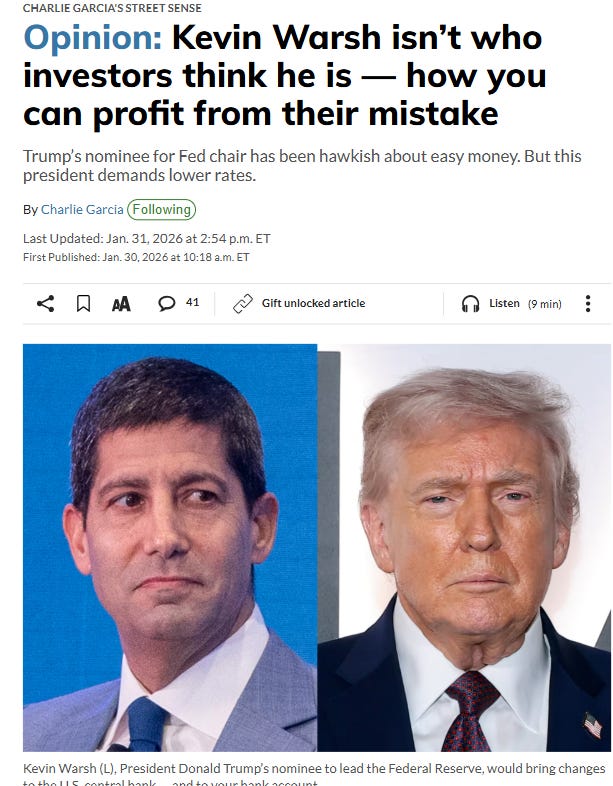
Do I want to keep doing this?
I’ll decide soon.
In the meantime, if you’ve been thinking about pledging, the current prices are the current prices. They won’t be forever. And I’m already past my own deadline.
May the mischief be with you,
Charlie
P.S. Pledge button broken? Click https://substack.com/settings. Go to your list of Subscriptions, click on Capital Mischief, and select Founding Member or whatever tier you want.
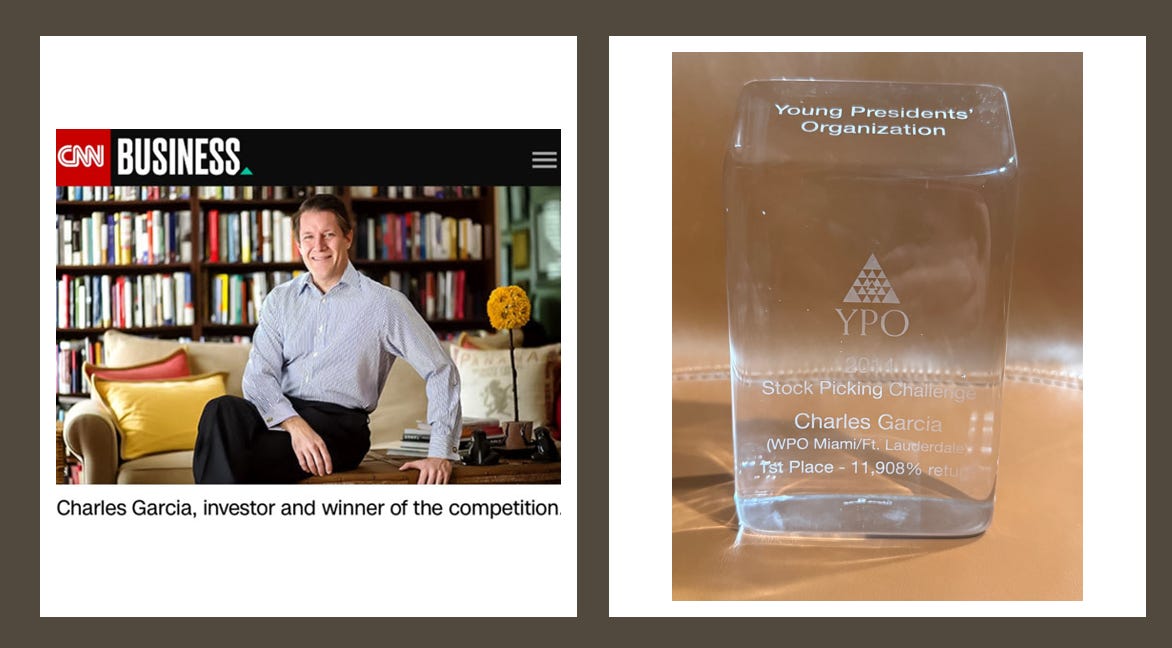
$120 Million in One Year. While Everyone Watched.
In 2014, YPO ran a yearlong simulated investment competition that CNN Business covered. Seventy-three global traders. One million dollars each. Everyone could see everyone else’s positions.
Imagine playing poker with your cards face-up.
After 2,870 trades in a year, I’d made $120 million. 11,908% return.
The other 72 traders combined made less. They could have copied me. They didn’t.
That tells you everything about why most people lose money even when they can see exactly what winners are doing.
Charlie,
The old Chinese curse ‘May you live in interesting times’ is upon us.
Xi may want, even need, a century, but does he have it? Demographics and a structurally moribund domestic economy seem to be contracting his window quite dramatically. Perhaps that’s something driving Beijing’s push to at least compete with, if not replace, the US$ as a (the?) reserve currency. Something that commodity traders are already preparing for.
Outwardly, the Trumpian tendency to disrupt might be just that, but taking account of the energy and geographical plays Trump is forcing, it could be that he understands that Xi is human just like he is, and that ultimately the result of this battle will rest on who survives longest in office.
To misquote Napoleon: “Apres ils, le deluge”?
Im not a conspiracy dealer, no Charlie, that is you...
Im into how you framed it.
Man, down and out.
"Bullet missed his brain"
"Blood running down his face"
"Raises his fist"..
Que the fireworks and the flyover...
Send in the marching band and get the convertible set for the parade.
Im not an argument person, I'm a realist. He appeals to a base that thinks his every move is a sign that he will lead them to the otherside. Making America great again!
I'll agree with the protection of the dollar argument 👌 and his actions, in your mind that he is instrumental in its delivery. I have too because im not that smart of an economist to know any different.
But you lose me in the impeachment, indictments, the alliance with Pedophile's, his families business dealings (while in office, ie Emoluments Clause)that could only happen because of his position in politics.
I have no problem with removing illegal aliens, but his methods are unacceptable.
I have quite a few questions about his methods and motivations in the areas of pardons, persecution of enemy's, motives of his administration etc.
And his wine, not the star spangled beat down you mentioned. As a former democrat I have alot of disappointment in my former party.
Covid checks, along with fiscal stimulus on steroids that drove inflation to the moon while straining supply chains, policy that was directed totally to seal a win in the upcoming election by buying, securing the votes needed through policy. He did not relinquish his grip on the party until proven unworthy against one of the weakest opponents in history (my take, and I'm entitled to it) and then appointed his successor without a primary.
My opinion, and mine only, but, in the past I have deferred way to much on Trump and his actions.
If you are honest to yourself, and I am sure you can be.
Ask yourself if the person addressing the public in the position of the presidency is someone you want your children to emulate? Would you have him as your CEO, if you were the CFO?
Are you proud of his method despite the results?
I have raised my children, I have tried to teach humility, fair play and respect. I have stressed taking responsibility for your actions and acceptance of others opinions and beliefs. I have failed myself and have been willing to accept the consequences and apologize when im wrong.
I apologize to you if I offended your beliefs, but do not pump up the person who I feel is a grifter and a con man who's only goal is to move up the Forbes wealthiest (from the 500's to the 200's in a year, congratulations to him) while selling out to the highest bidder.
With that I appreciate your posts but I will pushback, the same way I do to any of my Red Hat friends who wave their finger in my face and blast me with the same old, same old Republican talking points and deferred examples about Obama, Clinton and Biden.
I guess what I'm most sad about is that I hate politics and politicians as , as you say, they will say anything, do anything to get elected, while we have spun our wheels for years debating the same old problems
The economy
Healthcare
Immigration
Education
Social programs
Defense
Politics used to be, along with politicians some thing to be proud of, to grow up want to be one.
No thanks, I have a conscious and morals!